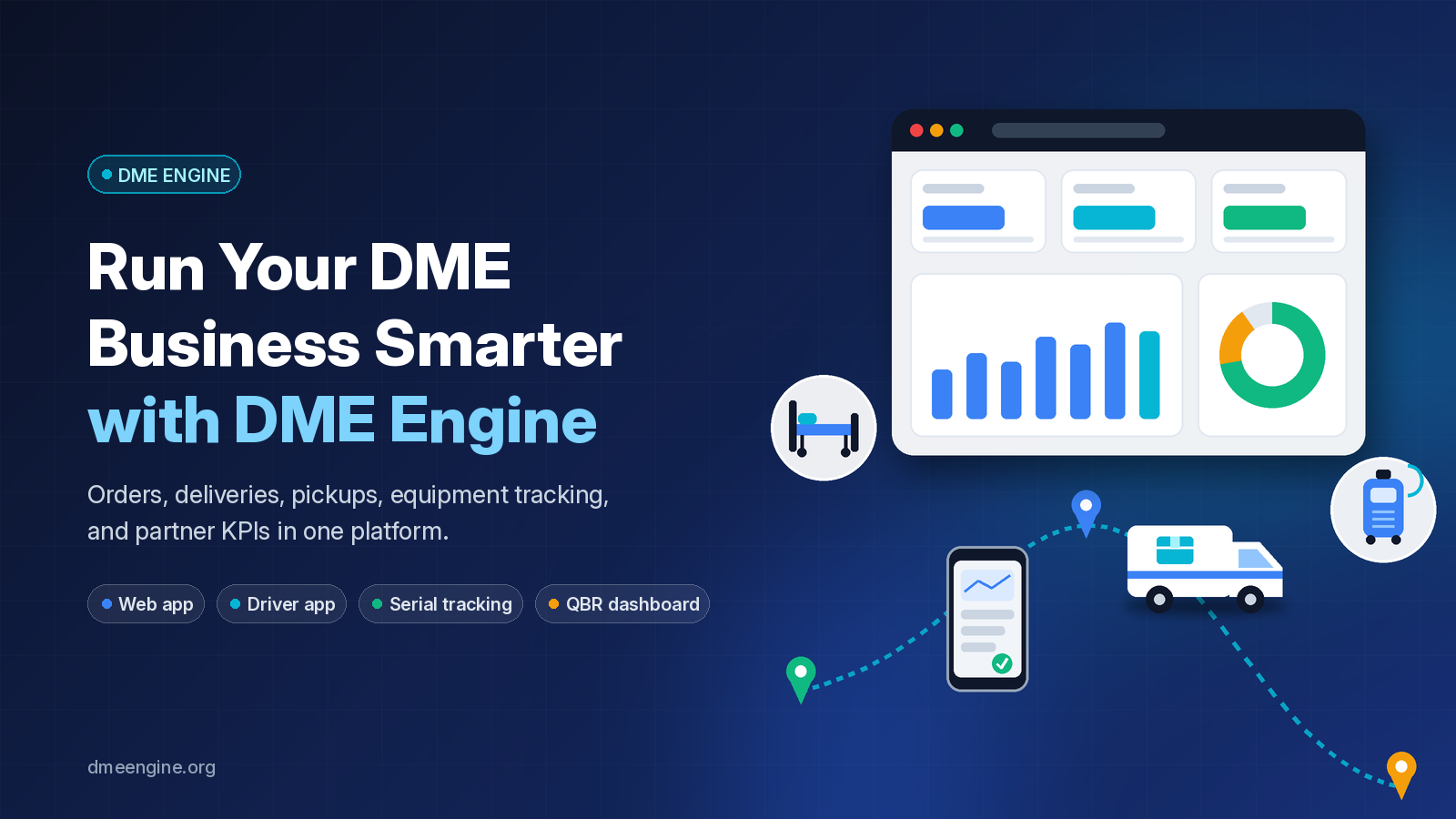
If you own or manage a DME company that serves hospices, you already know the job is not just delivering equipment. It is keeping a dozen moving parts in sync: new patients from several agencies, orders that need to go out today, drivers in the field, discharges that turn into pickups, serial numbers that have to land in the right place, and partners who want to know how their account is doing.
Most DME shops hold that together with phone calls, spreadsheets, and a few people who remember everything. That works until volume grows, a key person is out, or a hospice asks a question nobody can answer quickly.
DME Engine was built by DME providers, for DME providers, to put that whole workflow in one place. Here is what that looks like in practice and why it matters to owners and operations managers.
One system from referral to pickup
DME Engine covers the full equipment lifecycle in a single platform:
- Patients and orders. Office staff enter patients, create delivery orders, and add items from one web app.
- Delivery. Orders flow to drivers on the mobile app, with routing and a live truck map in the office.
- Discharge and pickup. When a hospice patient is discharged or passes, the pickup is scheduled, assigned, signed for, and returned to the warehouse in the same system.
- Equipment tracking. Barcode scanning, serial and lot tracking, and full item movement history follow each piece of equipment from receiving to the patient and back.
- Billing. Invoices are built from the same records, per agency or aggregated.
The benefit is simple. Everyone works from the same record. The office, the driver, billing, and the hospice partner are not each keeping their own version of what happened.
Let your hospice partners work in the system with you
Hospice agencies are your customers, and they do real work on every order. DME Engine gives them a web app where their staff can enter patients, create orders, discharge patients, and request pickups directly. Each agency can have its own online ordering portal.
For your team, that means fewer faxed or emailed orders to retype, fewer "did you get my order?" calls, and a cleaner handoff when a patient is discharged. For the hospice, it means placing and tracking work on their own schedule, including after hours.
Give drivers a real tool, not a clipboard
Your drivers are the face of your company at the bedside. DME Engine Driver is a native iPhone app available free on the Apple App Store. Drivers sign in with a company code, work today's route, scan items, add delivery comments, and capture a signature at completion. POD photos are optional, and teams can turn them on where they need photo evidence.
Because the app syncs with the office, dispatch sees progress on the truck map while drivers work, and the signed delivery lands on the same order record billing and compliance use later.
Know where every piece of equipment is
Hospital beds, oxygen concentrators, wheelchairs, and other rental equipment are your biggest assets. Losing track of them costs money twice: once for the equipment and again for the time spent looking for it.
DME Engine includes barcode printing and scanning, serial and lot number tracking, warehouse moves, purchase order receiving, and item movement history for chain of custody. When equipment is not returned, a lost item workflow keeps it from quietly disappearing. When someone asks "where is that concentrator?", the answer is a lookup, not a search party.
“Can’t thank you enough for DME Engine. You’ve really built something great 🙏”
Bill each hospice the way the contract says
Every hospice negotiates its own terms. DME Engine supports per-agency rate sheets by item or category, which you can clone or bulk-import from contract spreadsheets. Per-agency approval thresholds route orders over a set amount to a named approver, and each approval is stored on the delivery audit trail. STAT orders can bypass the queue or route after hours.
When month-end comes, invoices are generated from the same orders and rates, so the bill matches the contract instead of a spreadsheet someone rebuilt by hand.
Walk into every QBR with real numbers
Hospice partners want to know how the relationship is going, and you want to show them. DME Engine includes a QBR and account KPI dashboard with the numbers that matter for each account, including active patients, patients with equipment out, and pickup backlog.
That gives you a clear view of each account before a review meeting and a way to spot problems early. A growing pickup backlog, for example, is a signal to adjust routes or staffing before a partner has to bring it up.
Built for audits and HIPAA expectations
Hospices and their DME vendors are both closely audited. DME Engine keeps timestamped signatures, optional delivery photos, driver identity through PIN authentication, and item history per serial or lot number. Each company gets its own dedicated SQL database with role-based access controls, audit logging, and encrypted transmission. Business Associate Agreements are available for hospice and home health customers.
Priced for real DME companies
DME Engine is $200 per month for up to 10 users, with no per-user gouging. After setup, you can try it for 30 days with no credit card required.
FAQ
Who is DME Engine for? DME companies that serve hospice agencies, home health agencies, and medical supply contracts. It was built specifically for providers who deliver to hospices.
Can my hospice partners place orders themselves? Yes. Hospice staff can use the web app to enter patients, create orders, discharge patients, and request pickups. Each agency can have its own ordering portal.
Is there a mobile app for drivers? Yes. DME Engine Driver is free on the Apple App Store and covers routes, scanning, signatures, and optional POD photos.
Can I manage multiple hospice contracts in one system? Yes. DME Engine is multi-client by design, with separate pricing, contacts, approvers, and portals for each referral source.
How much does it cost? $200 per month for up to 10 users, with a 30-day free trial and no credit card required.
See it with your own workflow
The fastest way to judge DME Engine is to watch it handle your real orders, deliveries, and pickups. Book a 15-minute demo and we will walk through your workflow, not a slide deck.
Book a 15-minute demo or call 866-522-1138 ext. 3. Learn more at dmeengine.org.